Tuesday, 3 May 2011

'Embroidered Gardens'

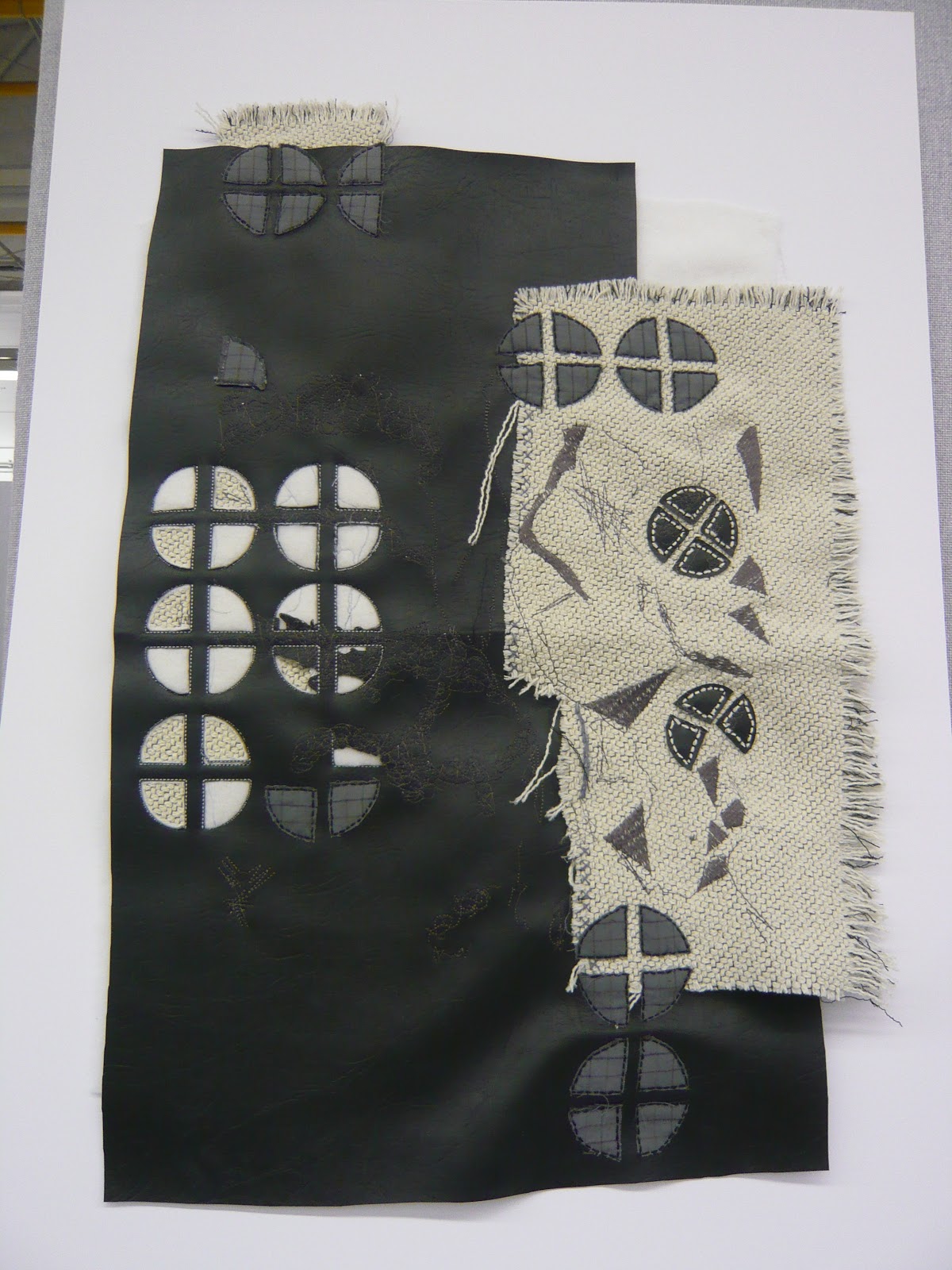
These are some of my final samples from my ‘Embroidered Gardens’ project from before Christmas. These samples have been inspired by some of the drawings from the previous post.
'Embroidered Garden' - Texture

'Embroidered Garden' - Texture [Detail]

'Embroidered Garden' - Pleated Leather [Detail]

'Embroidered Garden' - Sculpted Leather

'Embroidered Garden' - Sculpted Leather [Detail]

'Embroidered Garden' - Formal Garden
'Embroidered Garden' - Formal Garden [Detail]

'Embroidered Garden' - Quilted Rocks

'Embroidered Garden' - Layer

'Embroidered Garden' - Layer [Detail]
  
'Embroidered Garden' - Layer [Detail]

Sunday, 27 March 2011

It's been a while...

I haven’t blogged for months! I’m terrible! So I’m going to quickly update you on what’s been going on in my textiles.
My project before Christmas was inspired by natural forms and textures with a strong focus on gardens. I combined this with patterns found within formal garden design.
Below are some of my initial observation sketches, which I used to create digitalised stitch designs.


I used some new drawing techniques in this project using the Elmo scanner, a 3D scanner to help me. I would project my small-scale sketchbook works onto A2 & A1 paper as well as lengths of wallpaper. The scanner allowed me to zoom into various parts of my drawings creating an entirely new piece of work. I also scanned parts of my embroidery to draw from as well.
The image above shows me working from the projection of a drawing.


This image shows me working from the projection of a fabric on the left-hand page. On the right-hand page, I am working from the print left behind from a dyed fabric whilst drying.


I'm really pleased with my drawings from this project. I really developed my own style and learnt to draw on a larger scale. I’ve always preferred to work small-scale which is why I tend to work in little sketchbooks. The Elmo projection technique was a massive help. I think that because the projection leaves marks on a page, when you actually make the first physical mark, it seems a lot less daunting. “The white paper, usually of large dimensions, was threatening. The nervousness of making the first mark on the blank surface…” (Ionascu, 2006)


IONASCU, A. (2006) Drawing Lines – Ambiguous Surfaces, [Online] Available at:
www.lboro.ac.uk/departments/ac/tracey/ambi/images/ionascu.pdf [Accessed 14.12.2010]

Wednesday, 27 October 2010

What is contemporary about my work?

In my monograph module, we were asked to think about what makes our own work contemporary...

·         Quilting – non-traditional.
·         Influenced by other contemporary practitioners:
o   Claire Coles
o   Pauline Burbidge
o   Alice Kettle
o   Val Jackson
·         Use of technology:
o   Amaya (Computerised sewing machine)
o   CAD (Photoshop, Illustrator, Design OS, Amaya OS)
o   Laser-cutter
o   Digital Photography

Considering Val Jackson’s applique…

HOCKING, 2010, Photograph
I have adjusted this photograph of Val Jackson’s work to grayscale in order for me to appreciate the technique used.
Jackson’s use of stitch gives plain sections of fabric texture and depth with her pattern creating stitch. These patterns vary greatly from simplistic circular forms to swirls, flowers, and wavy lines.
By combining reverse applique with pattern creating stitch, Jackson forms some lovely sections of floral fabrics. This is a technique I would like to use in my own work.
I will be referring to this image throughout the project for technique ideas.

Friday, 15 October 2010

Currently…

My current project is still finding it’s feet and so am I.
My summer project was inspired by a field trip to London last academic year in which there was a visit to the Herbarium at Kew Gardens to study the library of specimens. So my project was based on gardens; flowers, plants and garden features such as gates, archways and rockeries. I drew from three separate gardens: my own, the holiday home I stayed at in France, and National Trust property Shugborough, in Staffordshire. These were all just initial drawings/sketches mainly working monochromatically in pencil or biro.
However, when I returned to uni in September with my three sketchbooks full of initial drawings I hit a block. I couldn’t develop them. It just was not working for me at all. It wasn’t until my first tutorial when I was prompted to think back to my strengths of last year that it hit me. What I had been doing was far too literal and involved very little texture. My strengths of last year were texture, quilting, and white work. In fact, the theme of my work was never obvious at all.
So it was back to the drawing board for me.
I went back to my gardens sketchbooks & picked out four key drawings, which I thought I could develop. Each involved texture and pattern. ..
Kew Gardens
France
Shugborough
My next step was to go to the library and research contemporary gardens, looking for images involving pattern and texture. It was from this research that I discovered the link between formal garden designs and interiors in particular wallpaper, architectural features, and carpet designs.

Mader, G. & Neubert-Mader, L. 1997, p.86

Fleming, L. & Gore, A. 1979, p.74

Mader, G. & Neubert-Mader, L. 1997, p.88
Mader, G. & Neubert-Mader, L. 1997, p.163
Wallpapers:

References:
Fleming, L. & Gore, A. (1979) The English Garden, Michael Joseph Ltd, London.
Mader, G. & Neubert-Mader, L. (1997) The English Formal Garden, Aurum Press Ltd, London.

Thursday, 14 October 2010

Where to begin?

So I want my blog to be a place to document my current drawing and embroidery work as well as feature designers I like, new inspiration, fashion and items of general interest to me be it a magazine article, a radio feature, something I've seen or heard.
Enjoy J